HOLRY Servo Motor Manufacturer
Ac servo motor set - HOLRY
Motors are the core power components in modern automation systems, industrial equipment, robotics, and machinery. Among various motor types, servo motors and normal motors (standard motors) are two widely used solutions. Although both convert electrical energy into mechanical motion, their working principles, control methods, performance, and applications are significantly different.
A normal motor is mainly designed for continuous rotation and basic power transmission, while a servo motor is developed for precise control of position, speed, and torque. Understanding the difference between a servo motor and a normal motor helps engineers select the right motor for their machines and improve system efficiency.
What Is The Mechanism Of A Servo Motor?
servo motoris a closed-loop motor system that uses feedback control to achieve accurate movement. Unlike a normal motor that simply runs when power is supplied, a servo motor continuously monitors its actual operation and adjusts itself according to the command signal.
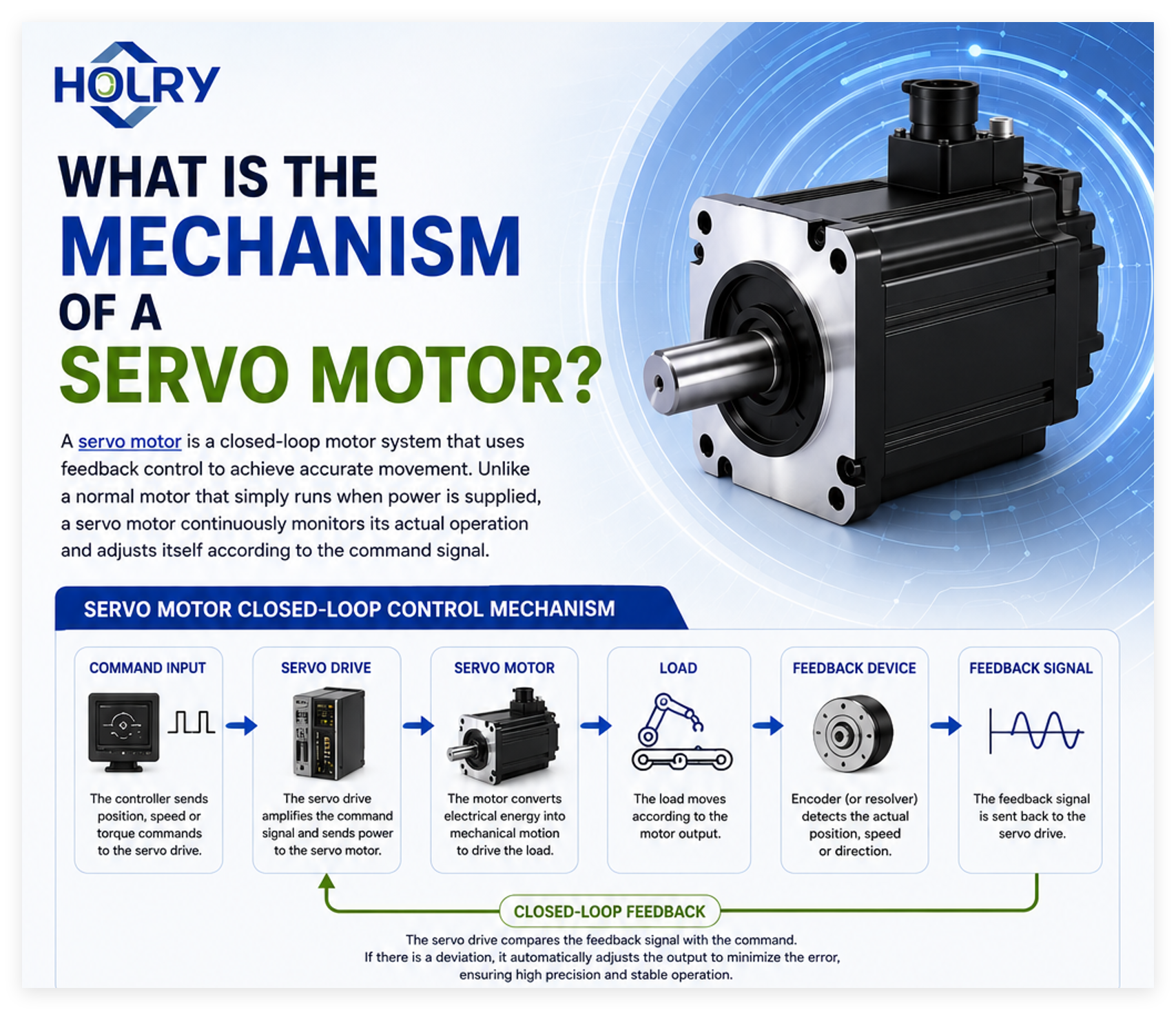
The basic working process includes five steps:
1. Input Signal (Command)
The servo system first receives a control signal from a controller, PLC, CNC system, or motion control unit.
This command tells the servo motor what action it needs to perform, such as:
For example, a CNC machine may send a signal requiring the motor shaft to move exactly 45 degrees.
2. Error Detection
A servo motor is equipped with feedback devices such as encoders or resolvers.
These components continuously measure the actual:
Position
Speed
Rotation direction
The control system compares the actual movement with the desired command. If there is any difference, the system identifies it as an error.
3. Error Correction
After detecting the difference between the target value and actual value, the servo controller automatically adjusts the motor output.
For example:
If the motor moves slower than required, the controller increases power.
If the motor exceeds the target position, the controller reduces output.
This closed-loop correction allows servo motors to achieve high accuracy.
4. Motor Action
Based on the correction signal, the servo motor changes its:
Rotation speed
Torque output
Position
The motor continues adjusting until the actual movement matches the command.
5. Continuous Feedback Loop
The feedback process operates continuously during operation.
This means servo motors can maintain precise control even under changing loads or working conditions.
Key Components In The Mechanism
A complete servo motor system usually includes:
In Simple Terms
A normal motor simply receives electricity and rotates, while a servo motor constantly checks its movement and corrects errors to achieve accurate control.
Can A Servo Motor Rotate Continuously?
The rotation capability of a servo motor depends on its type and application.
1. Standard Servo Motor
Standard servo motors are mainly designed for controlled angular movement.
Typical operation range:
0° to 180°
Limited rotation angles
They are commonly used in:
2. Continuous Rotation Servo Motor (360° Servo)
A continuous rotation servo motor can rotate continuously like a normal motor.
However, the control method is different:
Normal motors control mainly speed and direction.
Continuous servo motors control speed, direction, and feedback.
They are often used in:
Mobile robots
Automated vehicles
Small mechanical systems
3. Industrial Servo Motors
Industrial servo motors can rotate continuously while providing precise control.
They are widely used in:
What Is The Main Difference Between A Servo Motor And A Normal Motor?
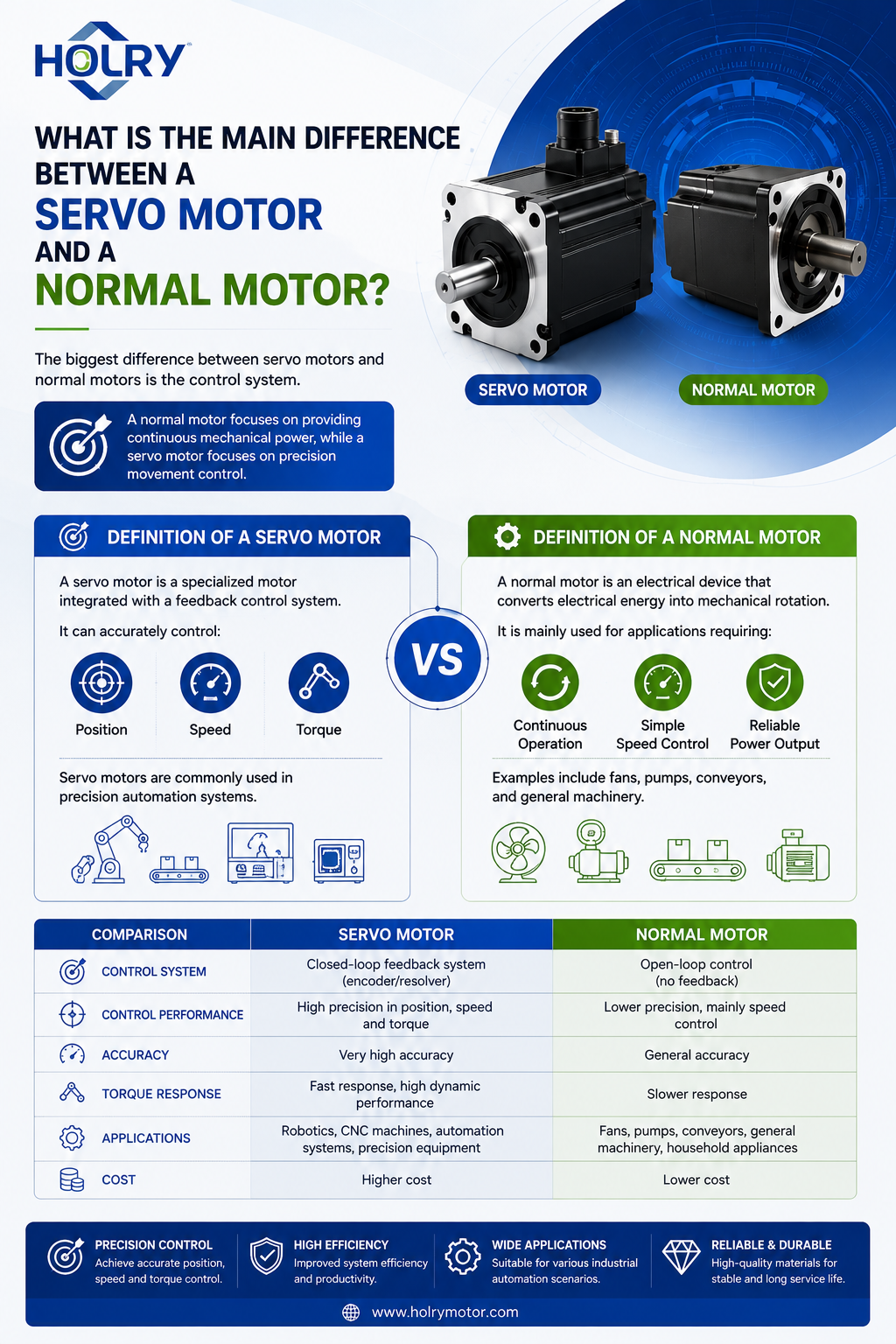
The biggest difference between servo motors and normal motors is the control system.
A normal motor focuses on providing continuous mechanical power, while a servo motor focuses on precision movement control.
Definition Differences
Definition Of A Normal Motor
A normal motor is an electrical device that converts electrical energy into mechanical rotation.
It is mainly used for applications requiring:
Continuous operation
Simple speed control
Reliable power output
Examples include fans, pumps, conveyors, and general machinery.
Definition Of A Servo Motor
A servo motor is a specialized motor integrated with a feedback control system.
It can accurately control:
Servo motors are commonly used in precision automation systems.
Construction Differences
Normal Motor Construction
A standard motor usually consists of:
Stator
Rotor
Bearings
Housing
It has a relatively simple structure and does not require advanced feedback components.
Servo Motor Construction
A servo motor includes additional components:
High-resolution encoder
Servo drive
Control circuit
Precision bearings
These components allow accurate monitoring and adjustment during operation.
Working Principle
Normal Motor
A normal motor operates based on electromagnetic principles.
When electricity is supplied, the magnetic field generates rotation. The motor continues running according to the applied voltage and load conditions.
Servo Motor
A servo motor operates through a closed-loop control system.
The controller continuously compares:
Target position → Actual position → Correction signal
This allows the motor to achieve high accuracy and stability.
Control Mechanism
Normal Motors
Normal motors usually use:
On/off control
Basic speed adjustment
Frequency control
They are suitable for applications where precise positioning is not required.
Servo Motors
Servo motors use advanced control systems:
Position feedback
Speed feedback
Torque feedback
They provide accurate motion control for complex machines.
Performance Characteristics
Speed Control
Normal motors provide general speed control but may have slower response times.
Servo motors provide:
Faster acceleration
Precise speed regulation
Dynamic response
Torque Control
Normal motors generate torque according to load conditions.
Servo motors can precisely control torque output, making them suitable for demanding applications.
Positioning Accuracy
Position accuracy is the biggest advantage of servo motors.
Servo systems can achieve extremely precise positioning, which is essential for robotics and CNC equipment.
Applications Of Normal Motors Vs Servo Motors
Applications Of Normal Motors
Normal motors are commonly used in:
Applications Of Servo Motors
Servo motors are widely used in:
Advantages Of Normal Motors
Advantages Of Servo Motors
Disadvantages Of Normal Motors
Disadvantages Of Servo Motors
Higher cost
More complex installation
Requires controller and drive system
Professional maintenance may be needed
Key Difference Between Servo Motor And Normal Motor
| Feature | Normal Motor | Servo Motor |
| Control Method | Open-loop | Closed-loop |
| Feedback System | Usually no feedback | Encoder feedback |
| Accuracy | Low | High |
| Position Control | Limited | Excellent |
| Cost | Lower | Higher |
| Application | General machines | Precision automation |
Jkongmotor Servo Motor
Jkongmotor provides high-performance servo motor solutions designed for industrial automation, robotics, CNC equipment, and precision motion applications.
Jkongmotor servo motors feature:
What Is The Lifespan Of A Servomotor?
The lifespan of a servo motor depends on operating conditions, load, environment, and maintenance.
Typical Lifespan Of Servo Motors
Industrial Servo Motors (AC/DC)
Industrial servo motors usually have a service life of:
With proper maintenance, some high-quality servo systems can operate longer.
Hobby Servo Motors (RC Or Small Robotics)
Small servo motors typically have shorter lifespans because they use lower-cost components and operate under lighter conditions.
Factors Affecting Lifespan
Load Conditions
Continuous overload operation increases heat and mechanical stress, reducing motor life.
Duty Cycle
Frequent acceleration, stopping, and reversing require stronger motor performance.
Temperature & Environment
High temperature, dust, moisture, and vibration can affect motor reliability.
Bearing And Encoder Wear
Bearings and feedback sensors are important components that may require inspection after long-term operation.
Maintenance
Regular inspection helps detect problems early and extend service life.
Signs Of Servo Motor Wear
Common signs include:
Increased noise
Reduced accuracy
Excessive vibration
Overheating
Abnormal error alarms
Extending The Lifespan
To improve servo motor durability:
Select the correct motor size
Avoid overload operation
Maintain proper cooling
Check electrical connections regularly
Follow maintenance schedules
How Do I Choose A Servo Motor For My Machine?
Choosing the correct servo motor requires evaluating several factors.
1. Define Your Application Requirements
Identify:
Machine type
Movement requirements
Accuracy needs
2. Determine Torque Requirements
Calculate the required torque according to:
Load weight
Acceleration
Mechanical resistance
3. Define Speed Needs
Choose a motor based on required:
RPM
Acceleration speed
Operating frequency
4. Check Accuracy And Resolution
For precision applications, select motors with high-resolution encoders.
5. Evaluate Size And Mounting
Ensure the motor fits:
Installation space
Shaft design
Mechanical structure
6. Consider Power Supply And Driver Compatibility
Check voltage, current, and controller compatibility.
7. Duty Cycle And Operating Environment
Consider:
Working hours
Temperature
Dust protection
8. Communication And Control Needs
Industrial servo systems may support:
CANopen
EtherCAT
Modbus
Pulse control
9. Reliability And Maintenance
Choose suppliers that provide technical support and quality assurance.
10. Cost Vs. Performance Balance
The best servo motor is not always the cheapest option. Selecting the correct balance between performance and cost ensures long-term efficiency.
The main difference between a servo motor and a normal motor is the level of control.
Normal motors are ideal for simple applications requiring continuous rotation and reliable power. Servo motors are designed for applications requiring precision, fast response, and accurate motion control.
For industrial automation, robotics, CNC machines, and advanced manufacturing equipment, servo motors provide significant advantages in accuracy and efficiency. Choosing the right motor depends on your machine requirements, load conditions, accuracy needs, and operating environment.

 Русский
 English
 العربية
 Français
 Español
 Português
 Deutsch
 italiano
 日本語
日本語 한국어
한국어 Nederlands
 Tiếng Việt
 ไทย
ไทย Polski
 Türkçe
 አማርኛ
አማርኛ Bahasa Melayu
 தமிழ்
தமிழ் Filipino
 Bahasa Indonesia
 magyar
 Română
 Čeština
 हिन्दी
 فارسی
فارسی Kiswahili
 Slovenčina
 Slovenščina
 Norsk
Norsk Svenska
 українська
 Ελληνικά
 Suomi
Suomi עברית
עברית Dansk
Dansk বাংলা
বাংলা Hrvatski
 Afrikaans
 Gaeilge
 Eesti keel
 Māori
Māori සිංහල
සිංහල Azərbaycan dili
 Euskara
 Беларуская мова
 Български
 guarani
 Kreyòl ayisyen
 Kurdî
Kurdî Lietuvių
 Македонски
 తెలుగు