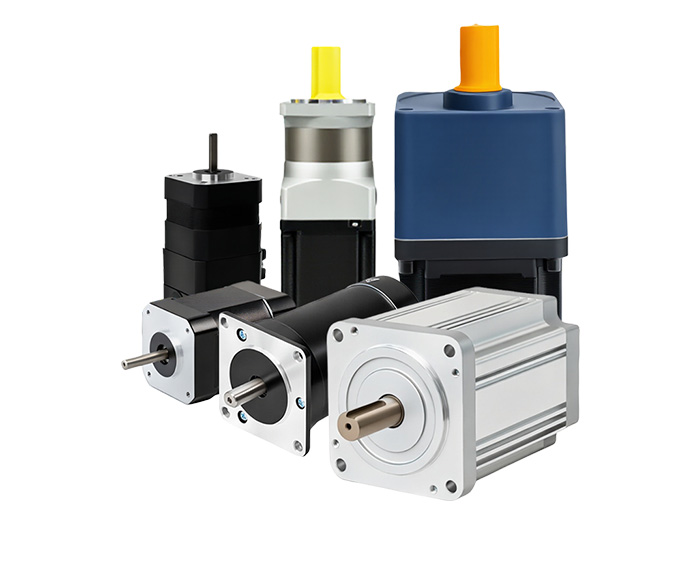
Brushless motors, also known as BLDC (Brushless DC) motors, are widely used in drones, electric vehicles, robotics, industrial automation, CNC machines, and many other applications due to their high efficiency, long lifespan, and excellent performance. However, unlike brushed motors, brushless motors require electronic control to operate properly.
A common question among engineers, hobbyists, and manufacturers is: Can I run a brushless motor without an ESC?
The short answer is: No, a standard brushless motor cannot operate normally without an ESC (Electronic Speed Controller). The ESC plays a critical role in controlling the motor’s electrical signals, speed, torque, and direction. Without it, the motor cannot perform the electronic commutation required for continuous rotation.
Understanding the Role of ESC in Brushless Motors
An ESC is the electronic controller that acts as the “brain” of a brushless motor system. It converts DC power from a battery or power supply into controlled three-phase electrical signals that drive the motor.
Unlike brushed motors, which use mechanical brushes and a commutator to switch current automatically, brushless motors rely on electronic switching. This switching process must be precisely controlled, and the ESC is responsible for managing it.
Electronic Commutation
The most important function of an ESC is electronic commutation.
A BLDC motor contains multiple stator windings and permanent magnets on the rotor. To make the rotor spin, the magnetic field inside the motor must rotate continuously. The ESC achieves this by switching current between the motor phases in the correct sequence.
Without electronic commutation, the magnetic field cannot rotate properly, meaning the motor will usually fail to start or will only move slightly.
Speed Control
ESCs regulate motor speed by adjusting the voltage and frequency of electrical pulses delivered to the motor.
By changing the PWM (Pulse Width Modulation) signal, the ESC controls how much power reaches the motor, allowing precise speed adjustment for different operating conditions.
Direction Control
A brushless motor’s rotation direction depends on the order of phase switching.
The ESC can reverse motor direction by changing the phase sequence, which is essential for applications such as robotics, electric vehicles, and industrial equipment.
Torque Management
ESCs continuously adjust current delivery to maintain proper torque output.
During startup or heavy loads, the ESC increases current supply to provide more torque while preventing excessive stress on the motor.
Protection Features
Modern ESCs include multiple safety functions, such as:
These features help protect both the motor and the power supply system.
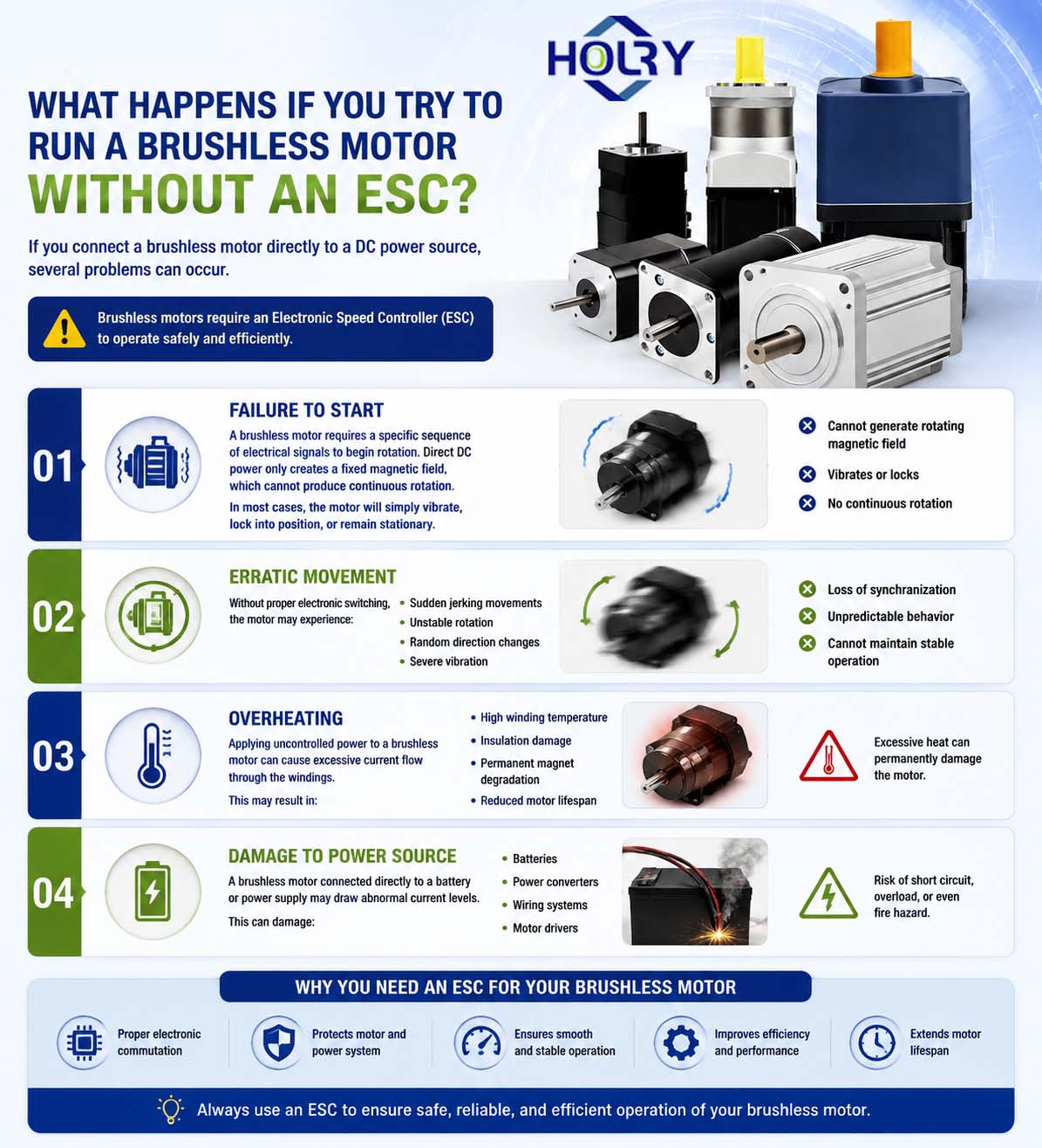
What Happens if You Try to Run a Brushless Motor Without an ESC?
If you connect a brushless motor directly to a DC power source, several problems can occur.
Failure to Start
A brushless motor requires a specific sequence of electrical signals to begin rotation. Direct DC power only creates a fixed magnetic field, which cannot produce continuous rotation.
In most cases, the motor will simply vibrate, lock into position, or remain stationary.
Erratic Movement
Without proper electronic switching, the motor may experience:
Sudden jerking movements
Unstable rotation
Random direction changes
Severe vibration
The motor cannot maintain synchronization between the rotating magnetic field and the rotor.
Overheating
Applying uncontrolled power to a brushless motor can cause excessive current flow through the windings.
This may result in:
Damage to Power Source
A brushless motor connected directly to a battery or power supply may draw abnormal current levels.
This can damage:
Batteries
Power converters
Wiring systems
Motor drivers
Why ESCs Are Indispensable for BLDC Motors
ESCs are not optional accessories for most brushless motor applications. They provide the essential control functions required for safe and efficient operation.
1. Electronic Commutation
ESCs replace the mechanical commutation system found in brushed motors by electronically switching current through motor phases.
This enables smooth and continuous rotation.
2. Precision Speed Control
ESCs allow accurate speed adjustment through PWM control, making brushless motors suitable for applications requiring precise movement.
3. Torque Regulation
By controlling current output, ESCs ensure the motor delivers sufficient torque while avoiding excessive electrical stress.
4. Direction Control
Changing phase timing allows the ESC to easily reverse motor rotation without changing mechanical connections.
5. Safety and Protection
ESC protection systems reduce the risk of motor failure caused by overload, overheating, or abnormal voltage conditions.
6. Customization and Flexibility
Many ESCs allow parameter adjustment, including:
Acceleration settings
Maximum speed limits
Braking response
Motor timing
7. Efficiency Optimization
Proper ESC control improves energy efficiency by ensuring the motor operates within its optimal performance range.
Can You Run a Brushless Motor With Alternatives to ESC?
Although a traditional ESC is the most common solution, there are other methods to control a brushless motor.
1. Manual Three-Phase Switching
It is technically possible to manually switch three-phase power signals using electronic circuits. However, this requires precise timing and is impractical for most applications.
2. Custom Microcontroller Circuit
Engineers can design their own controller using microcontrollers, sensors, and power MOSFETs.
This approach is used in research projects and customized industrial systems but requires advanced electrical knowledge.
3. Synchronous AC Drive
Some brushless motors can operate with specialized AC drives that provide controlled three-phase power.
This is common in industrial automation systems.
4. Laboratory Demonstrations
For educational purposes, engineers may operate BLDC motors without commercial ESCs using custom circuits. However, these setups are not recommended for everyday applications.
Differences Between Brushed and Brushless Motors in ESC Dependence
1. Commutation Method
Brushed Motors:
Brushed motors use mechanical brushes and a commutator to automatically switch current direction.
Brushless Motors:
Brushless motors require electronic switching, which is normally provided by an ESC.
2. Starting and Operation
Brushed Motors:
A brushed motor can start immediately when connected to DC power.
Brushless Motors:
A brushless motor needs electronic timing control to start and maintain rotation.
3. Speed and Torque Control
Brushed Motors:
Speed control is usually achieved by adjusting voltage.
Brushless Motors:
Speed and torque require electronic regulation through an ESC.
4. Efficiency and Wear
Brushed Motors:
Mechanical brushes create friction and wear over time.
Brushless Motors:
Brushless motors have longer service life but depend on electronic controllers.
5. ESC Dependence Summary
Brushed Motors
Brushless Motors
Require electronic commutation
Need ESC or equivalent controller
Provide higher efficiency and performance
Risks of Running Without ESC
Operating a brushless motor without proper electronic control can create several risks.
1. Motor Fails to Start or Operates Erratically
Incorrect switching prevents stable rotation and can cause vibration or stalling.
2. Overheating and Thermal Damage
Uncontrolled current may permanently damage motor windings.
3. Electrical Hazards
Incorrect wiring can damage batteries, circuits, and power supplies.
4. Loss of Performance and Efficiency
Without proper control, the motor cannot achieve rated speed, torque, or efficiency.
5. Mechanical Stress and Wear
Repeated vibration and unstable operation can damage bearings and mechanical components.
6. Safety Risks to Users
Overheated motors or damaged electrical systems may create safety hazards.
When Is Sensorless Control Acceptable?
Sensorless brushless motor control is widely used in many applications, but it has limitations.
1. Applications with Smooth Startup Requirements
Sensorless control works well when the motor can gradually accelerate without heavy starting loads.
2. High-Speed Operations
At high speeds, sensorless control can accurately estimate rotor position.
3. Cost-Sensitive Applications
Removing position sensors can reduce system cost.
4. Applications Where Torque Ripples Are Acceptable
Some applications can tolerate minor variations in torque output.
5. Not Suitable for Precise Motion or Heavy Loads at Startup
Robotics, CNC equipment, and heavy machinery often require sensor-based control for accurate positioning.
Best Practices for Using Brushless Motors
To achieve reliable performance, follow these guidelines:
1. Always Use a Properly Rated ESC
Choose an ESC that matches motor voltage, current, and power requirements.
2. Ensure Correct Motor Wiring
Incorrect phase connections may cause reverse rotation or poor performance.
3. Configure ESC Parameters Appropriately
Adjust timing, acceleration, and current limits according to motor specifications.
4. Maintain Proper Cooling
Use appropriate heat dissipation methods for high-load applications.
5. Avoid Overloading the Motor
Operating beyond rated limits can shorten motor lifespan.
6. Use Appropriate Power Supplies
Ensure batteries or power sources provide stable voltage and sufficient current.
7. Regular Maintenance and Inspection
Check wiring, connectors, and cooling systems regularly.
8. Use Sensorless Motors Appropriately
Select sensorless control only when application requirements allow it.
9. Plan for Safety
Always include electrical protection and proper installation practices.
A brushless motor depends on electronic commutation, speed regulation, torque management, and protection functions provided by an ESC or an equivalent motor controller.
While custom circuits and specialized drives can replace a traditional ESC, they require advanced control systems and are not suitable for typical applications.
For drones, robotics, electric vehicles, industrial machines, and automation equipment, using a properly matched ESC is the safest and most efficient way to achieve reliable brushless motor performance.

 Русский
 English
 العربية
 Français
 Español
 Português
 Deutsch
 italiano
 日本語
日本語 한국어
한국어 Nederlands
 Tiếng Việt
 ไทย
ไทย Polski
 Türkçe
 አማርኛ
አማርኛ Bahasa Melayu
 தமிழ்
தமிழ் Filipino
 Bahasa Indonesia
 magyar
 Română
 Čeština
 हिन्दी
 فارسی
فارسی Kiswahili
 Slovenčina
 Slovenščina
 Norsk
Norsk Svenska
 українська
 Ελληνικά
 Suomi
Suomi עברית
עברית Dansk
Dansk বাংলা
বাংলা Hrvatski
 Afrikaans
 Gaeilge
 Eesti keel
 Māori
Māori සිංහල
සිංහල Azərbaycan dili
 Euskara
 Беларуская мова
 Български
 guarani
 Kreyòl ayisyen
 Kurdî
Kurdî Lietuvių
 Македонски
 తెలుగు