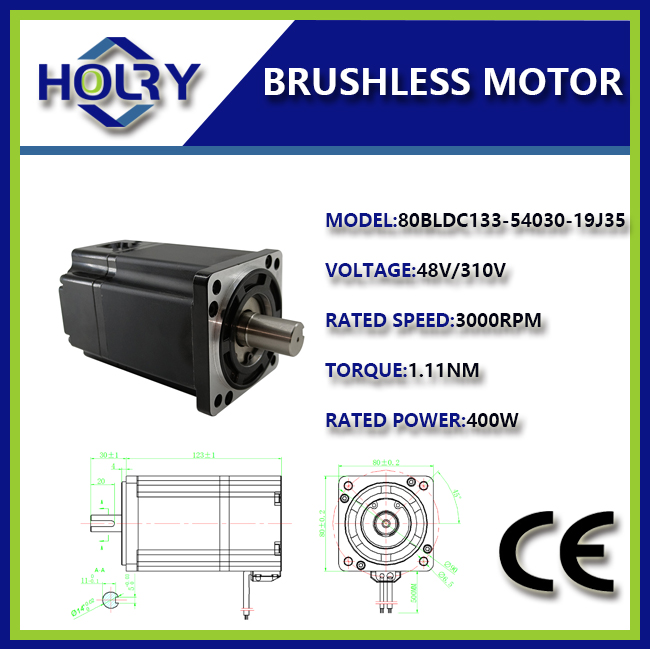
A 3 Phase BLDC Motor (Three Phase Brushless DC Motor) is an advanced electric motor that uses electronic commutation instead of mechanical brushes and a commutator to generate rotation. Unlike traditional brushed DC motors, BLDC motors rely on a controller to switch current between three stator phases, creating a rotating magnetic field that drives the permanent magnet rotor.
Due to their high efficiency, long service life, low maintenance requirements, and excellent speed control performance, 3 Phase BLDC motors are widely used in electric vehicles, industrial automation, drones, robotics, medical devices, and many other modern applications.
The three-phase design provides smoother torque output, higher power density, and better operational stability compared with single-phase BLDC motors, making it an ideal solution for applications requiring reliable and precise motion control.
Construction and Working Principle
3 Phase BLDC motor mainly consists of several key components, including the stator, permanent magnet rotor, electronic controller, Hall sensors (or sensorless control system), and motor housing.
The stator contains three-phase windings arranged at specific electrical angles. The rotor uses permanent magnets to generate a fixed magnetic field. When the electronic controller supplies current to different stator phases in sequence, a rotating magnetic field is created, forcing the rotor magnets to follow this movement and produce mechanical rotation.
Working Mechanism
The working process of a 3 Phase BLDC motor follows these steps:
The controller receives a speed or position command.
The control system determines the correct switching sequence.
Current is supplied to different stator windings through electronic switches.
The generated magnetic field interacts with the rotor magnets.
The rotor rotates continuously following the changing magnetic field.
Because the commutation process is controlled electronically, BLDC motors achieve faster response, higher efficiency, and more accurate operation compared with brushed motors.
Advantages of 3 Phase BLDC Motors
1. High Efficiency and Performance
One of the biggest advantages of 3 Phase BLDC motors is their excellent energy efficiency. The absence of brushes reduces friction and electrical losses, allowing more electrical energy to be converted into mechanical power.
These motors can maintain high performance even during continuous operation, making them suitable for energy-sensitive applications such as EVs and renewable energy systems.
2. Low Maintenance and High Durability
Since BLDC motors do not use carbon brushes, there is no brush wear or replacement requirement. This significantly reduces maintenance costs and improves operating reliability.
The longer service life makes them especially suitable for industrial equipment, automation systems, and applications where downtime must be minimized.
3. Precise Speed and Torque Control
With electronic control technology, 3 Phase BLDC motors provide accurate speed regulation and excellent torque management.
By adjusting current, voltage, and switching frequency, users can achieve precise control for applications requiring smooth acceleration, stable operation, and dynamic response.
4. Compact Design and Lightweight
The high power-to-weight ratio of BLDC motors allows manufacturers to design smaller and lighter systems without sacrificing performance.
This compact structure makes them widely used in drones, robotic equipment, portable tools, and other space-limited applications.
Commutation Techniques in 3 Phase BLDC Motors
Commutation is the process of switching current between motor phases to maintain continuous rotation. In 3 Phase BLDC motors, two common commutation methods are used.
1. Trapezoidal Commutation
Trapezoidal commutation, also known as six-step commutation, is one of the most common control methods for BLDC motors.
The controller energizes two phases at a time while leaving one phase inactive. This method is simple, cost-effective, and suitable for many general applications.
However, it may produce more torque ripple and noise compared with advanced control methods.
2. Sinusoidal Commutation
Sinusoidal commutation provides smoother current waveforms, resulting in lower vibration, reduced noise, and more stable torque output.
Although it requires a more complex controller, it is preferred for high-precision applications such as robotics, medical equipment, and advanced automation systems.
Sensor-Based vs. Sensorless Control
Sensor-Based BLDC Motors
Sensor-based BLDC motors use Hall sensors or position sensors to detect rotor position. The controller uses this feedback information to perform accurate commutation.
Advantages include reliable starting performance, precise control, and stable operation at low speeds.
Sensorless BLDC Motors
Sensorless BLDC motors estimate rotor position by monitoring back electromotive force (Back EMF) generated by the motor.
This design reduces system cost, improves reliability, and eliminates sensor failures. However, sensorless motors may require advanced algorithms for low-speed operation and startup control.
Applications of 3 Phase BLDC Motors
3 Phase BLDC motors are widely used across various industries due to their efficiency and controllability.
1. Electric Vehicles (EVs)
BLDC motors provide high torque density and excellent efficiency, making them suitable for electric cars, electric motorcycles, and electric bicycles.
2. Drones and UAVs
The lightweight structure and fast response of BLDC motors make them the preferred choice for drone propulsion systems.
3. Industrial Automation
They are used in robotic arms, CNC machines, conveyor systems, and automated manufacturing equipment.
4. Home Appliances
Modern appliances such as air conditioners, washing machines, and refrigerators use BLDC motors to improve energy efficiency.
5. Medical Equipment
Medical devices require quiet and reliable operation, making BLDC motors ideal for pumps, imaging equipment, and surgical systems.
6. HVAC Systems
BLDC motors improve fan efficiency and reduce energy consumption in heating, ventilation, and air conditioning systems.
7. Power Tools
Cordless drills, grinders, and other professional tools use BLDC motors for higher power output and longer operating time.
8. Office Equipment
Printers, scanners, and automation devices benefit from the precise movement control of BLDC technology.
9. Aerospace and Defense
High reliability and lightweight performance make BLDC motors suitable for aerospace control systems and defense equipment.
10. Renewable Energy Systems
BLDC motors are applied in solar tracking systems, wind energy equipment, and other clean energy technologies.
Speed Control of 3 Phase BLDC Motors
Speed control is a critical function that determines motor performance and efficiency.
1. Role of Electronic Speed Controllers (ESCs)
ESCs control current switching, motor speed, acceleration, and braking functions. They are essential components in most BLDC systems.
2. Pulse Width Modulation (PWM) Technique
PWM controls motor speed by adjusting the average voltage supplied to the motor. A higher duty cycle increases speed, while a lower duty cycle reduces speed.
3. Closed-Loop Control with Feedback
Closed-loop systems use feedback signals from sensors to continuously adjust motor operation, ensuring accurate speed and torque control.
4. Open-Loop Control
Open-loop control operates without feedback. It is simpler and cheaper but provides lower accuracy compared with closed-loop systems.
5. Field-Oriented Control (FOC) / Vector Control
FOC is an advanced control method that improves torque response, efficiency, and smooth operation by precisely controlling magnetic fields.
6. Sensor-Based vs. Sensorless Speed Control
The selection depends on application requirements. Sensor-based systems offer higher accuracy, while sensorless systems provide lower cost and improved durability.
7. Voltage Control Method
Adjusting the motor supply voltage can influence speed, although modern systems typically combine voltage control with PWM technology.
8. Importance of Soft Start
Soft start technology reduces startup current and mechanical stress, improving motor lifespan and system reliability.
9. Dynamic Braking and Speed Reduction
Dynamic braking allows rapid speed reduction by converting kinetic energy into electrical energy, improving safety and control.
Thermal Management and Protection
Although BLDC motors are highly efficient, heat management remains important during continuous operation.
Effective cooling methods, temperature monitoring, overload protection, and current limiting systems help prevent overheating and extend motor life.
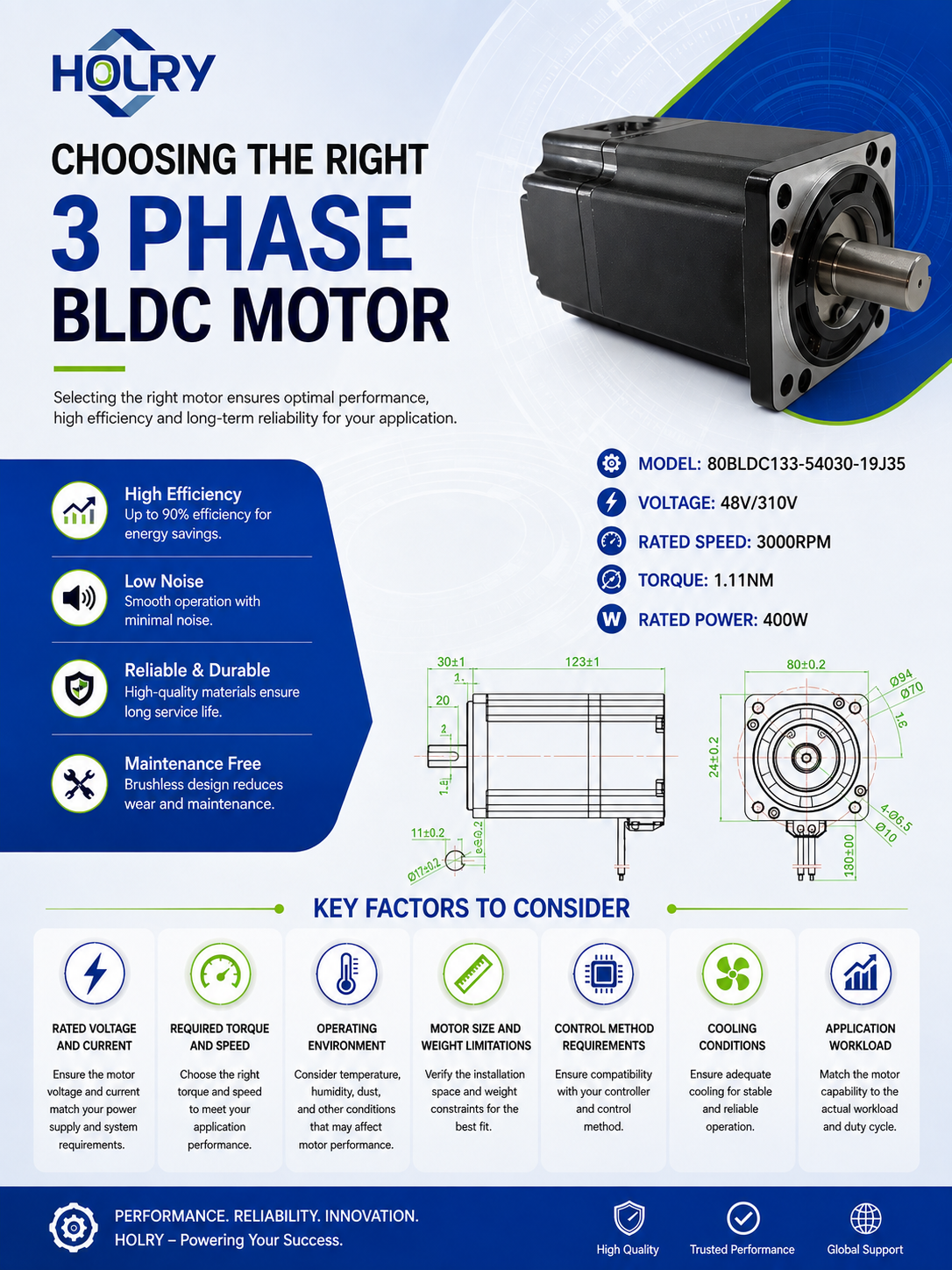
Choosing the Right 3 Phase BLDC Motor
When selecting a 3 Phase BLDC motor, important factors include:
Rated voltage and current
Required torque and speed
Operating environment
Motor size and weight limitations
Control method requirements
Cooling conditions
Application workload
Types of BLDC Motors
BLDC motors can be classified according to rotor structure, including:
Inner rotor BLDC motors
Outer rotor BLDC motors
High-speed BLDC motors
High-torque BLDC motors
jkongmotor BLDC Motors
jkongmotor BLDC motors provide reliable brushless motor solutions designed for industrial equipment, automation systems, robotics, and customized applications. With advanced manufacturing technology and flexible customization capabilities, these motors deliver efficient performance, stable operation, and long service life.
Future of 3 Phase BLDC Motors
1. Growing Demand in Electric Mobility
The rapid development of electric vehicles will continue increasing demand for efficient and powerful BLDC motor solutions.
2. Integration with IoT and Smart Systems
Future BLDC motors will become more intelligent through IoT connectivity, real-time monitoring, and smart control systems.
3. Advancements in Motor Control Techniques
Improved algorithms such as advanced FOC will enhance efficiency, response speed, and operating accuracy.
4. Energy Efficiency and Environmental Impact
Higher-efficiency motors will help reduce energy consumption and support global sustainability goals.
5. Miniaturization and Compact Designs
Manufacturers are developing smaller motors with higher power density for portable and intelligent devices.
6. Widespread Adoption in Automation and Robotics
The growth of robotics will further increase demand for precise and reliable BLDC motors.
7. Cost Reduction and Mass Customization
Improved manufacturing processes will make BLDC motors more affordable while supporting customized solutions.
8. Enhanced Durability for Harsh Environments
Future BLDC motors will offer stronger protection against dust, moisture, vibration, and extreme temperatures.
3 Phase BLDC motors represent one of the most important advancements in modern motor technology. With high efficiency, precise control, compact structure, and long service life, they have become essential components in electric vehicles, automation systems, consumer electronics, and industrial equipment.
As industries continue moving toward intelligent, energy-efficient, and automated solutions, the demand for advanced 3 Phase BLDC motors will continue to grow, driving further innovation in motor design and control technology.

 Русский
 English
 العربية
 Français
 Español
 Português
 Deutsch
 italiano
 日本語
日本語 한국어
한국어 Nederlands
 Tiếng Việt
 ไทย
ไทย Polski
 Türkçe
 አማርኛ
አማርኛ Bahasa Melayu
 தமிழ்
தமிழ் Filipino
 Bahasa Indonesia
 magyar
 Română
 Čeština
 हिन्दी
 فارسی
فارسی Kiswahili
 Slovenčina
 Slovenščina
 Norsk
Norsk Svenska
 українська
 Ελληνικά
 Suomi
Suomi עברית
עברית Dansk
Dansk বাংলা
বাংলা Hrvatski
 Afrikaans
 Gaeilge
 Eesti keel
 Māori
Māori සිංහල
සිංහල Azərbaycan dili
 Euskara
 Беларуская мова
 Български
 guarani
 Kreyòl ayisyen
 Kurdî
Kurdî Lietuvių
 Македонски
 తెలుగు